
resource
BLOCK CHAIN
What is Blockchain Technology? A Step-by-Step Guide For Beginners
[Updated – Mar 01 2019]TLDR:
A blockchain is a growing list of records, called blocks, which are linked using cryptography. Each block contains a cryptographic hash of the previous block a timestamp, and transaction data (generally represented as a Merkle tree).
By design, a blockchain is resistant to modification of the data. It is “an open, distributed ledger that can record transactions between two parties efficiently and in a verifiable and permanent way
Is Blockchain Technology the New Internet?
The blockchain is an undeniably ingenious invention – the brainchild of a person or group of people known by the pseudonym, Satoshi Nakamoto. But since then, it has evolved into something greater, and the main question every single person is asking is: What is Blockchain?
By allowing digital information to be distributed but not copied, blockchain technology created the backbone of a new type of internet. Originally devised for the digital currency, Bitcoin, (Buy Bitcoin) the tech community has now found other potential uses for the technology.
In thisguide, we are going to explain to you what the blockchain technology is, and what its properties are that make it so unique. So, we hope you enjoy this, What Is Blockchain Guide. And if you already know what blockchain is and want to become a blockchain developer please check out our in-depth blockchain tutorial and create your very first blockchain.

What is Blockchain Technology?

 “The blockchain is an incorruptible digital ledger of economic transactions that can be programmed to record not just financial transactions but virtually everything of value.” – Don & Alex Tapscott, authors Blockchain Revolution (2016).

A blockchain is, in the simplest of terms, a time-stamped series of immutable record of data that is managed by cluster of computers not owned by any single entity. Each of these blocks of data (i.e. block) are secured and bound to each other using cryptographic principles (i.e. chain).
So, what is so special about it and why are we saying that it has industry disrupting capabilities?
The blockchain network has no central authority — it is the very definition of a democratized system. Since it is a shared and immutable ledger, the information in it is open for anyone and everyone to see. Hence, anything that is built on the blockchain is by its very nature transparent and everyone involved is accountable for their actions.
Blockchain Explained
A blockchain carries no transaction cost. (An infrastructure cost yes, but no transaction cost.) The blockchain is a simple yet ingenious way of passing information from A to B in a fully automated and safe manner. One party to a transaction initiates the process by creating a block. This block is verified by thousands, perhaps millions of computers distributed around the net. The verified block is added to a chain, which is stored across the net, creating not just a unique record, but a unique record with a unique history. Falsifying a single record would mean falsifying the entire chain in millions of instances. That is virtually impossible. Bitcoin uses this model for monetary transactions, but it can be deployed in many others ways.
Think of a railway company. We buy tickets on an app or the web. The credit card company takes a cut for processing the transaction. With blockchain, not only can the railway operator save on credit card processing fees, it can move the entire ticketing process to the blockchain. The two parties in the transaction are the railway company and the passenger. The ticket is a block, which will be added to a ticket blockchain. Just as a monetary transaction on blockchain is a unique, independently verifiable and unfalsifiable record (like Bitcoin), so can your ticket be. Incidentally, the final ticket blockchain is also a record of all transactions for, say, a certain train route, or even the entire train network, comprising every ticket ever sold, every journey ever taken.
But the key here is this: it’s free. Not only can the blockchain transfer and store money, but it can also replace all processes and business models which rely on charging a small fee for a transaction. Or any other transaction between two parties.
Here is another example. The gig economy hub Fivver charges 0.5 dollars on a 5 transaction between individuals buying and selling services. Using blockchain technology the transaction is free. Ergo, Fivver will cease to exist. So will auction houses and any other business entity based on the market-maker principle.
Even recent entrants like Uber and AirBnB are threatened by blockchain technology. All you need to do is encode the transactional information for a car ride or an overnight stay, and again you have a perfectly safe way that disrupts the business model of the companies which have just begun to challenge the traditional economy. We are not just cutting out the fee-processing middle man, we are also eliminating the need for the match-making platform.
Because blockchain transactions are free, you can charge minuscule amounts, say 1/100 of a cent for a video view or article read. Why should I pay The Economist or National Geographic an annual subscription fee if I can pay per article on Facebook or my favorite chat app. Again, remember that blockchain transactions carry no transaction cost. You can charge for anything in any amount without worrying about third parties cutting into your profits.

Blockchain may make selling recorded music profitable again for artists by cutting out music companies and distributors like Apple or Spotify. The music you buy could even be encoded in the blockchain itself, making it a cloud archive for any song purchased. Because the amounts charged can be so small, subscription and streaming services will become irrelevant.
It goes further. Ebooks could be fitted with blockchain code. Instead of Amazon taking a cut, and the credit card company earning money on the sale, the books would circulate in encoded form and a successful blockchain transaction would transfer money to the author and unlock the book. Transfer ALL the money to the author, not just meager royalties. You could do this on a book review website like Goodreads, or on your own website. The marketplace Amazon is then unnecessary. Successful iterations could even include reviews and other third-party information about the book.
In the financial world the applications are more obvious and the revolutionary changes more imminent. Blockchains will change the way stock exchanges work, loans are bundled, and insurances contracted. They will eliminate bank accounts and practically all services offered by banks. Almost every financial institution will go bankrupt or be forced to change fundamentally, once the advantages of a safe ledger without transaction fees is widely understood and implemented. After all, the financial system is built on taking a small cut of your money for the privilege of facilitating a transaction. Bankers will become mere advisers, not gatekeepers of money. Stockbrokers will no longer be able to earn commissions and the buy/sell spread will disappear.
How Does Blockchain Work?
Picture a spreadsheet that is duplicated thousands of times across a network of computers. Then imagine that this network is designed to regularly update this spreadsheet and you have a basic understanding of the blockchain.
Information held on a blockchain exists as a shared — and continually reconciled — database. This is a way of using the network that has obvious benefits. The blockchain database isn’t stored in any single location, meaning the records it keeps are truly public and easily verifiable. No centralized version of this information exists for a hacker to corrupt. Hosted by millions of computers simultaneously, its data is accessible to anyone on the internet.
To go in deeper with the Google spreadsheet analogy, I would like you to read this piece from a blockchain specialist.
 “The traditional way of sharing documents with collaboration is to send a Microsoft Word document to another recipient, and ask them to make revisions to it. The problem with that scenario is that you need to wait until receiving a return copy before you can see or make other changes because you are locked out of editing it until the other person is done with it. That’s how databases work today. Two owners can’t be messing with the same record at once.That’s how banks maintain money balances and transfers; they briefly lock access (or decrease the balance) while they make a transfer, then update the other side, then re-open access (or update again).With Google Docs (or Google Sheets), both parties have access to the same document at the same time, and the single version of that document is always visible to both of them. It is like a shared ledger, but it is a shared document. The distributed part comes into play when sharing involves a number of people.
Imagine the number of legal documents that should be used that way. Instead of passing them to each other, losing track of versions, and not being in sync with the other version, why can’t *all* business documents become shared instead of transferred back and forth? So many types of legal contracts would be ideal for that kind of workflow. You don’t need a blockchain to share documents, but the shared documents analogy is a powerful one.” – William Mougayar, Venture advisor, 4x entrepreneur, marketer, strategist and blockchain specialist
The reason why the blockchain has gained so much admiration is that:
- It is not owned by a single entity, hence it is decentralized
- The data is cryptographically stored inside
- The blockchain is immutable, so no one can tamper with the data that is inside the blockchain
- The blockchain is transparent so one can track the data if they want to
The Three Pillars of Blockchain Technology
The three main properties of Blockchain Technology which has helped it gain widespread acclaim are as follows:
- Decentralization
- Transparency
- Immutability
Pillar #1: Decentralization
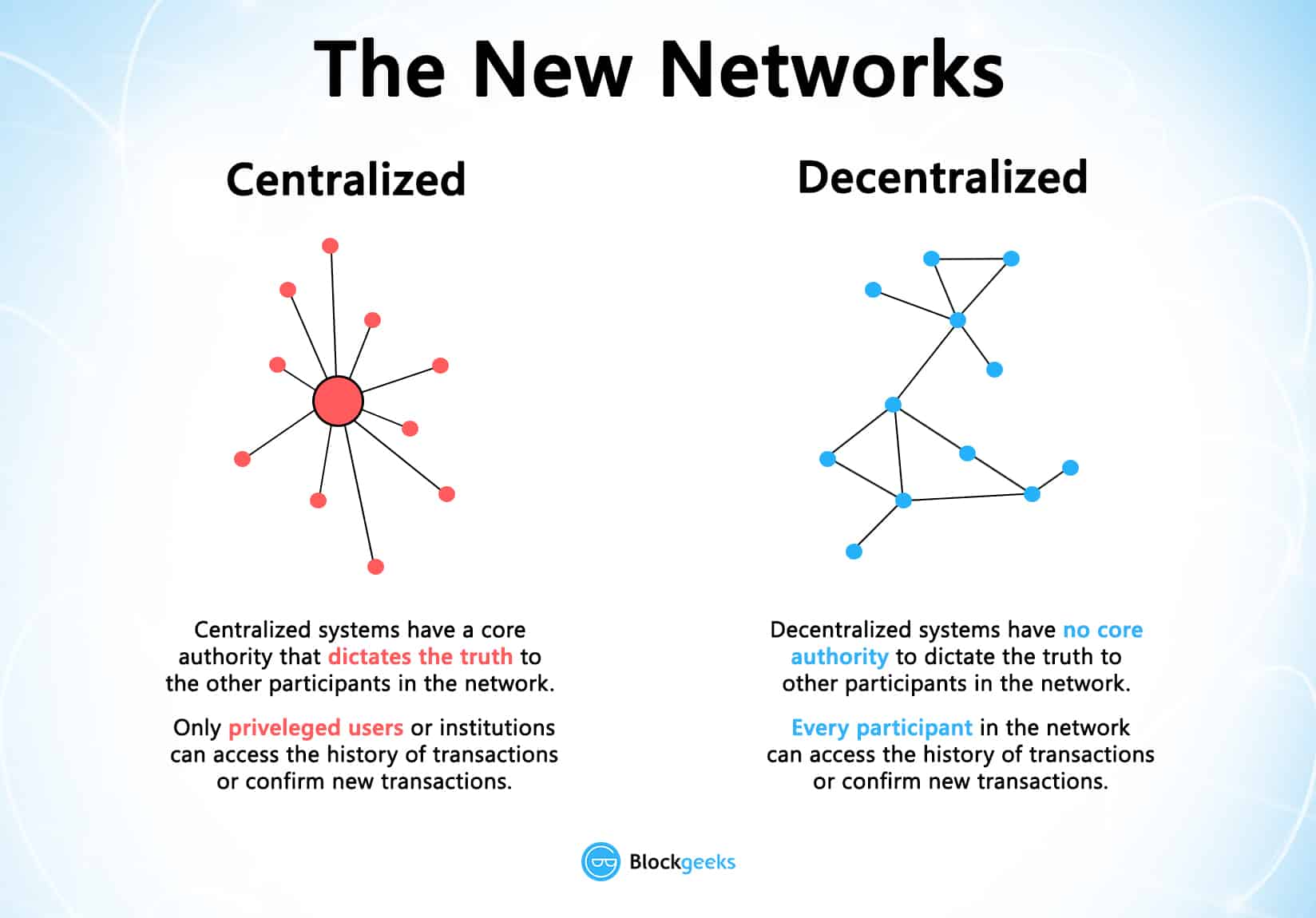
Before Bitcoin and BitTorrent came along, we were more used to centralized services. The idea is very simple. You have a centralized entity which stored all the data and you’d have to interact solely with this entity to get whatever information you required.
Another example of a centralized system is banks. They store all your money, and the only way that you can pay someone is by going through the bank.
The traditional client-server model is a perfect example of this:
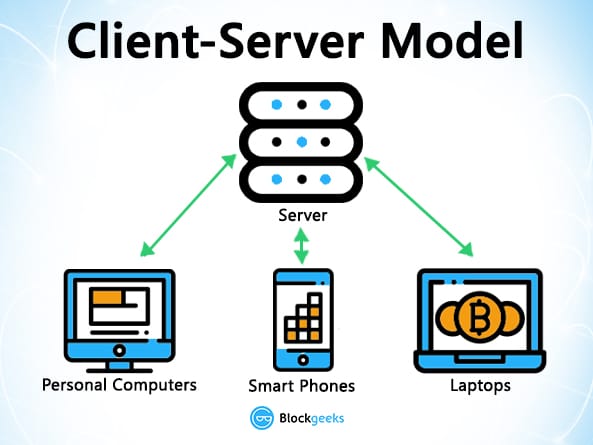
When you google search for something, you send a query to the server who then gets back at you with the relevant information. That is simple client-server.
Now, centralized systems have treated us well for many years, however, they have several vulnerabilities.
- Firstly, because they are centralized, all the data is stored in one spot. This makes them easy target spots for potential hackers.
- If the centralized system were to go through a software upgrade, it would halt the entire system
- What if the centralized entity somehow shut down for whatever reason? That way nobody will be able to access the information that it possesses
- Worst case scenario, what if this entity gets corrupted and malicious? If that happens then all the data that is inside the blockchain will be compromised.
So, what happens if we just take this centralized entity away?
In a decentralized system, the information is not stored by one single entity. In fact, everyone in the network owns the information.
In a decentralized network, if you wanted to interact with your friend then you can do so directly without going through a third party. That was the main ideology behind Bitcoins. You and only you alone are in charge of your money. You can send your money to anyone you want without having to go through a bank.

Pillar #2: Transparency
One of the most interesting and misunderstood concepts in blockchain technology is “transparency.” Some people say that blockchain gives you privacy while some say that it is transparent. Why do you think that happens?
Well… a person’s identity is hidden via complex cryptography and represented only by their public address. So, if you were to look up a person’s transaction history, you will not see “Bob sent 1 BTC” instead you will see “1MF1bhsFLkBzzz9vpFYEmvwT2TbyCt7NZJ sent 1 BTC”.
The following snapshot of Ethereum transactions will show you what we mean:

So, while the person’s real identity is secure, you will still see all the transactions that were done by their public address. This level of transparency has never existed before within a financial system. It adds that extra, and much needed, level of accountability which is required by some of these biggest institutions.
Speaking purely from the point of view of cryptocurrency, if you know the public address of one of these big companies, you can simply pop it in an explorer and look at all the transactions that they have engaged in. This forces them to be honest, something that they have never had to deal with before.
However, that’s not the best use-case. We are pretty sure that most of these companies won’t transact using cryptocurrencies, and even if they do, they won’t do ALL their transactions using cryptocurrencies. However, what if the blockchain technology was integrated…say in their supply chain?
You can see why something like this can be very helpful for the finance industry right?
Pillar #3: Immutability
Immutability, in the context of the blockchain, means that once something has been entered into the blockchain, it cannot be tampered with.
Can you imagine how valuable this will be for financial institutes?
Imagine how many embezzlement cases can be nipped in the bud if people know that they can’t “work the books” and fiddle around with company accounts.
The reason why the blockchain gets this property is that of cryptographic hash function.
In simple terms, hashing means taking an input string of any length and giving out an output of a fixed length. In the context of cryptocurrencies like bitcoin, the transactions are taken as an input and run through a hashing algorithm (bitcoin uses SHA-256) which gives an output of a fixed length.
Let’s see how the hashing process works. We are going to put in certain inputs. For this exercise, we are going to use the SHA-256 (Secure Hashing Algorithm 256).
